Updated November 2026.
Your website looks good and people visit it, but the phone stays quiet and the contact form brings in little. So you look for a web design agency that builds a website that gets more enquiries. But which agency is that? This article explains what such a website relies on, how to tell whether an agency really designs for it and how to measure afterwards whether it works.
Short answer: the web design agency that gets you more enquiries is the one that starts with your customers’ questions, makes the route to contact short and clear, builds forms people actually complete, delivers a fast and accessible website on mobile and measures how many enquiries come in. An agency that promises a fixed number of enquiries without knowing your situation cannot keep that promise.
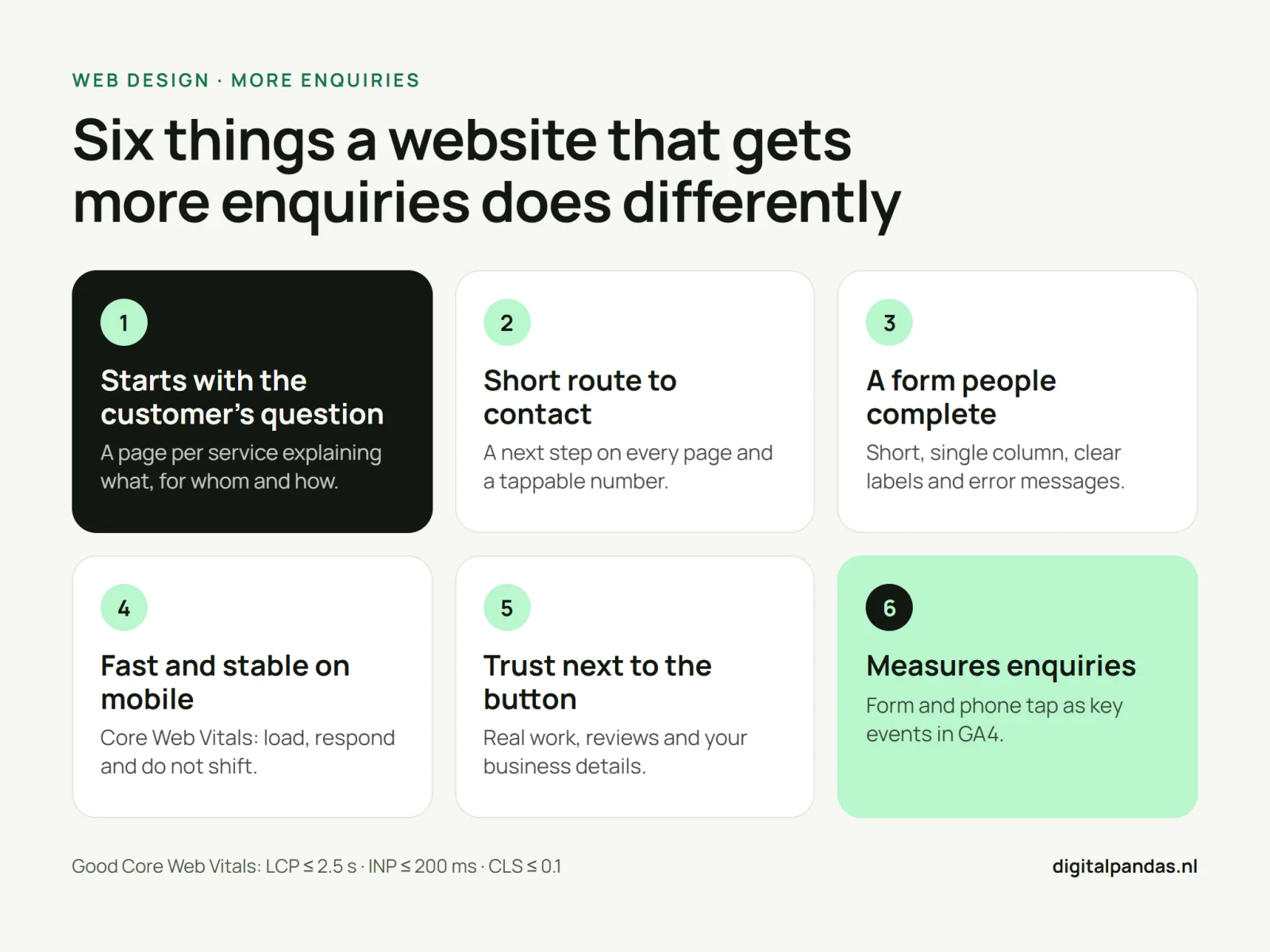
1. The agency starts with your customer’s question
People only get in touch when they are sure you can solve their problem. So a good agency first asks: what questions do customers come to you with, what do they hesitate about and what do they want to know before they call? That leads to a page per service explaining what you do, for whom, how it works and what the next step is. If the first meeting starts with colours and a logo, you mainly get a beautiful website, not necessarily one that gets more enquiries.
2. The route to contact is short and visible everywhere
Contact details do not belong on the contact page alone. A website that gets more enquiries has:
- a clear next step on every service page, such as ‘Request a quote’ or ‘Book an introduction’;
- a phone number you can tap directly on mobile;
- several ways to get in touch, for people who prefer to call, email or fill in a form;
- an explanation of what happens after the enquiry and when people can expect a reply.
That last one is easy to forget, but it removes doubt. Someone who knows they will be called back within a working day is more likely to fill something in.
3. Forms people actually complete
The contact form is the last part of the route, and that is where many visitors drop off. Usability researchers at the Nielsen Norman Group give guidelines including these: keep the form short, put fields in a single column, place labels close to the fields, do not use placeholder text in the field as a replacement for a label, make clear which fields are required and give a visible, specific error message when something goes wrong.
The WCAG accessibility guidelines say the same: fields must have a label or instructions, and if the form detects an error, it should explain how to fix it where possible. Buttons and links must be at least 24 by 24 pixels, or have enough space around them. That helps everyone tapping on a phone.
Also, do not ask for more than you need. Under the GDPR, you may not collect more personal data than necessary for the purpose. For a first enquiry, a name, an email address or phone number and a short question are often enough. Watch the spam protection too: the W3C points out that classic CAPTCHAs, such as retyping distorted letters, are a barrier for many people with disabilities. A good agency chooses a less demanding solution.
4. Fast and stable on mobile
A page that loads slowly or shifts while you try to tap costs enquiries. Google measures this with the Core Web Vitals. For a good experience, the largest element should load within 2.5 seconds (LCP), the page should respond to a tap or click within 200 milliseconds (INP) and the layout should barely shift, with a CLS of 0.1 or less. Google recommends meeting these values for at least 75 per cent of visits, on both mobile and desktop. Google also says its ranking systems reward content that provides a good page experience.
So ask an agency how it tests speed and how the website works on a phone. Read more in mobile-first design and responsive web design.
5. Trust sits close to the button
Doubt often arises just before getting in touch: are they reliable, have they done this before? Show real work, explaining what you did. Place reviews and examples near your contact button. State your business details: in the Netherlands, businesses offering services online must show their KVK number and VAT number on their website, among other things. A clear privacy statement next to the form belongs there too. Read what else visitors look for in how to spot a reliable web designer.
6. The agency measures enquiries, not just visitors
Without measurement, you will not know whether the new website gets more enquiries. In Google Analytics 4, you mark important actions as a ‘key event’ (previously called a conversion), such as a submitted form or a tap on your phone number. A standard GA4 property lets you set up to 30 key events. Agree with the agency which actions you measure and how often you review the figures together. Read how in improve your website with GA4. Make sure measurement respects your visitors’ cookie choices, see Google Consent Mode explained.
7. The right visitors find you
A website that converts well still needs visitors, preferably people searching for your service. That calls for pages that match search questions, a sound technical foundation and, for local businesses, a strong Google Business Profile. Read which SEO agency helps a local business. Want enquiries sooner? Then Google Ads and Meta Ads can send visitors straight to the right page.
The biggest mistake: a beautiful website without a route
Many websites are designed as a business card: nice images, a slogan and a contact page at the bottom. Visitors then have to work out for themselves whether you can help and how to reach you. Every page should have one job: explain something, help compare or make contact easy. An agency that names that job for each page is designing for enquiries.
Checklist: 8 questions for a web design agency
- What do you want to know about my customers before you design?
- What is the job of each page, and where is the next step?
- What will the contact form look like, and which fields are really needed?
- Does the website meet the WCAG accessibility guidelines?
- How do you test speed and the Core Web Vitals on mobile?
- Which actions will we measure as key events in Google Analytics?
- How do you check that form messages actually arrive?
- What do we do after launch if the number of enquiries is disappointing?
Want to ask us these questions too? Book an introduction.
Going further: test your own website today
Take your phone and pretend to be a new customer. Can you see within a few seconds what your business does? Can you find a way to get in touch without searching? Fill in your own form and check that the message arrives, including in the spam folder. This test takes ten minutes and often shows exactly where enquiries are leaking away. Spot several bottlenecks? Then a new website may be worthwhile. Read how much a website costs in the Netherlands.
How Digital Pandas designs websites
We start with your offer and your customers’ questions, and give every page a clear job: explain, help compare or make contact possible. We do not promise a fixed number of enquiries, because that depends on your market and offer. See our approach to web design, the Kledinginzamelbak case with a focused enquiry structure and more work in our projects.
Frequently asked questions about getting more enquiries through your website
How many enquiries can I expect?
There is no honest standard figure. It depends on your market, your offer, your price and how many people visit your website. So first measure how many enquiries you get now, so you can compare after an improvement.
How many fields should a contact form have?
As few as possible. Only ask what you need to reply properly. Extra questions, such as budget or timing, are better made optional or asked in the first conversation.
Is a form better than calling or WhatsApp?
It differs per customer. Some people prefer to call, others send a message in the evening. So offer several options and measure which is used most.
Should I put prices on my website?
You do not have to, but a price indication or an explanation of how your price is made up helps visitors judge whether you suit them. You then get fewer but better enquiries from people who already know what to expect.
Digital Pandas helps business owners in Julianadorp, Den Helder and the rest of North Holland get a website that helps visitors choose and get in touch. Want to know where your website is missing enquiries? Tell us what you want to improve or get to know the agency first.