Updated November 2026.
Your customers are not spread across the whole country, but live in your own region. Then an SEO approach that mainly chases national rankings is of little use. What you do need: to be found by people in your service area, at the moment they search for your service. This article explains which regional SEO approach works, step by step, and which popular trick you are better off skipping.
Short answer: regional SEO works best when you tackle four things together. A correctly set up Google Business Profile that matches how you work. A website with strong service pages that explain your real service area. Local prominence through genuine reviews and mentions. And measuring enquiries from your region. Do not create a series of pages that only swap a place name: Google treats that as spam.
1. Start with how you serve customers
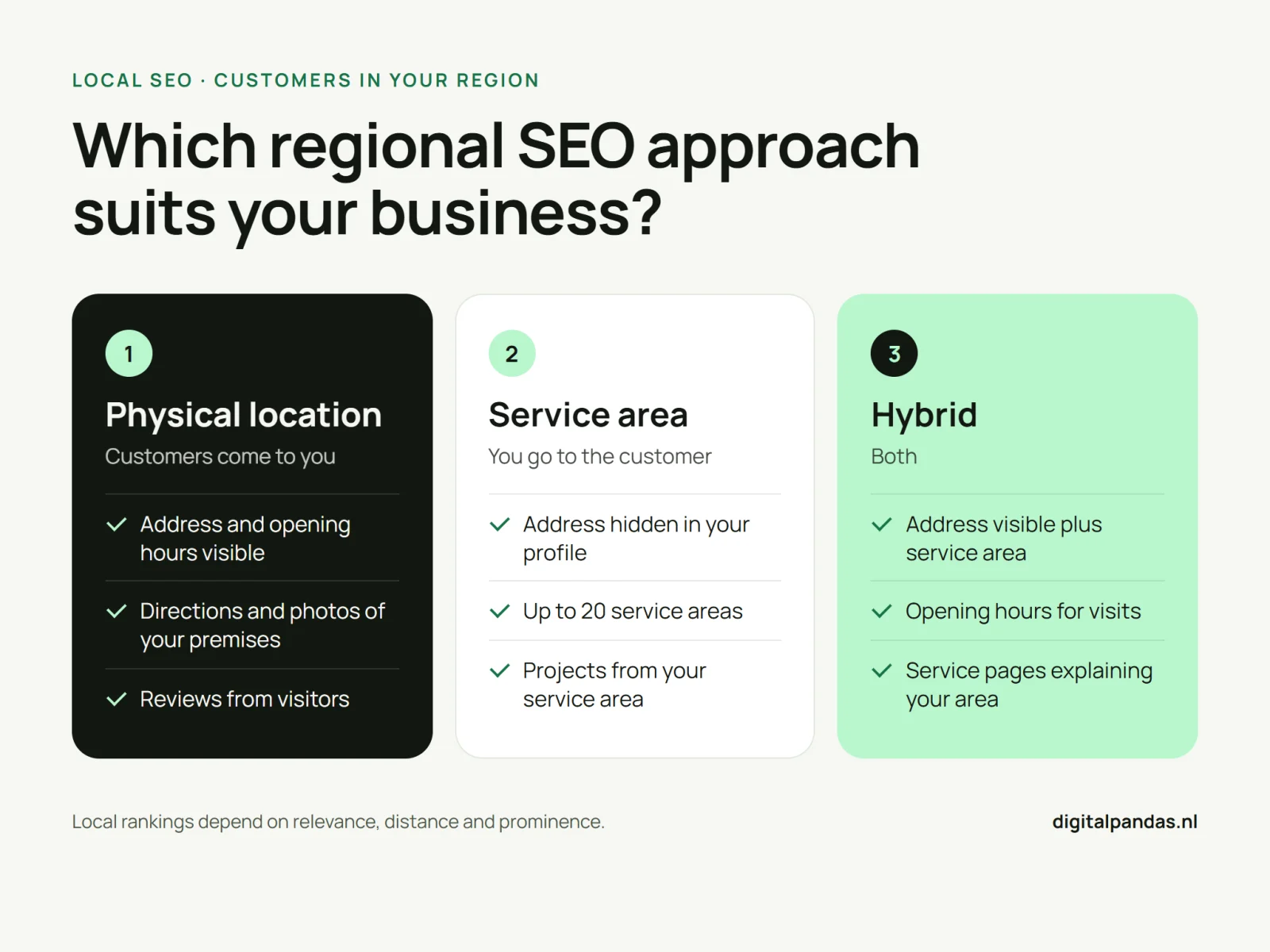
The right regional SEO approach depends on one question: do customers come to you, do you go to the customer, or both? Google makes the same distinction in the Business Profile:
- Physical location: customers come to you, as with a shop or practice. You show your address and opening hours.
- Service-area business: you visit or deliver to customers, but do not serve them at your address. You hide your address and set a service area. If you work from home, as many installers and cleaning companies do, your home address should not be visible in the profile.
- Hybrid business: you serve customers at your address and also visit them. Then you may show your address and also set a service area.
According to Google, a virtual office or rented mailing address without staff or customer visits does not count as a location. So choose the type that truly fits your business. Everything else builds on it.
2. Set up your Google Business Profile properly
Google names three main factors for local results: relevance, distance and prominence. According to Google, businesses with complete and accurate information are more likely to be shown. Pay particular attention to:
- Your real business name: the same name as on your shopfront, website and stationery, without extra keywords. Unnecessary words can lead to your profile being suspended.
- Your service area: you can set up to 20 service areas, based on cities, postcodes or other areas. Choose the areas where you really work.
- The right category and opening hours, including special hours around holidays.
- Photos of your real work, your van, your team or your premises.
You will find a detailed plan for your profile and reviews in our practical local SEO plan.
3. Build service pages that explain your service area
Your Business Profile points to your website, and that is where the decision is made. Create a clear page for each service: what you do, for whom, how it works and roughly what it costs or how the price is made up. Mention your service area naturally: where you are based, which places you work in and whether you also travel outside that region.
A separate page for one place can make sense, but only if it adds something of its own. Think of a real branch, a dedicated team, projects in that place or an offer that differs there.
4. Show real work from your region
The strongest regional content is proof that you work in the region. A project page about a job in Den Helder or Schagen, with photos, the customer’s question and the solution, is far more convincing for visitors than text that only says you ‘also work in Den Helder’. It also gives Google real, unique information about your service area. See how we describe projects in our projects, for example the brand identity and website for Kings Cleaning.
5. Help Google understand your details
Make sure your business name, address and phone number are the same everywhere on your website as in your Business Profile. Also add structured data of the LocalBusiness type. This tells Google your opening hours and contact details, among other things. A name and address are required. Google can use this data in the knowledge panel that appears next to the search results. A good web developer handles this in the technical setup of your website. Read why technology and content go together in SEO and web design.
6. Become known in your region
For prominence, Google looks at factors such as how many websites link to your business and how many reviews you have. A regional business has opportunities here that national companies do not:
- ask satisfied customers for an honest review and respond to every review;
- get listed by local clubs, business associations or events you are genuinely involved in;
- work with other local businesses, such as a builder and an installer who refer to each other;
- share news or projects with local media when there is something worth telling.
Do not buy links or reviews. According to Google, links mainly intended to manipulate rankings are link spam, and reviews given in exchange for a reward are removed.
7. Measure enquiries from your region
Do not check your ranking by searching on your own phone. Google says search results depend on the time, location, device and recent history of the person searching. Someone three villages away may see something different. Instead, look in Google Search Console at the queries you appear for, for example with a filter on place names. Measure in Google Analytics which visitors submit a form or call. Read how in improve your website with GA4. And make sure visitors actually get in touch, see a website that gets more enquiries.
The biggest mistake: a page per place name
A popular trick is to create an almost identical page for every place in your region: ‘Cleaning company Den Helder’, ‘Cleaning company Schagen’ and ‘Cleaning company Alkmaar’, each with the same text. Google calls this doorway abuse. As examples, Google mentions multiple pages targeted at specific regions or cities that funnel users to one page, and blocks of text listing cities and regions a page is trying to rank for. Spend that time on a strong service page and real projects from your region instead.
Checklist: regional SEO in 8 steps
- Choose the right profile type: physical location, service area or hybrid.
- Use your real business name, without extra keywords.
- Set your service area to the places where you really work (up to 20).
- Create a page per service that also explains your service area.
- Publish projects from your region, with photos and explanation.
- Keep name, address and phone number consistent and add LocalBusiness data.
- Ask for genuine reviews and look for local mentions.
- Measure queries in Search Console and enquiries in Analytics.
Want to know how your business scores on these points? Book an introduction.
Going further: answer the questions from your region
Customers in a region often ask the same questions. Is a dormer allowed without a permit in this municipality? Do you also come to the islands? How quickly can you be there? Write down those questions when customers ask them, and answer them on your service pages or in an article. That content is useful for visitors and fits how people search, including in AI answers. Read more in which SEO agency helps a local business. Want to be visible in your region sooner? Then you can combine SEO with regionally targeted Google Ads and Meta Ads.
How Digital Pandas helps regional businesses
We work from Julianadorp for business owners in Den Helder, the rest of North Holland and beyond. We tailor content to your real service area, look at your Business Profile and website together, and only create a local page when it really adds something. Read more about our approach to SEO and content, or book an introduction straight away.
Frequently asked questions about regional SEO
Do I need a separate page for every place?
No. Start with strong service pages that explain your service area. A page per place only makes sense if it contains something of its own, such as a branch, a team or projects in that place. Google treats near-identical pages that only change the place name as spam.
I work from home. Should my address be visible?
If you do not serve customers at your address, Google treats you as a service-area business. You then hide your address in your Business Profile and set a service area. That way you can still be found in the places where you work.
How many places can I add to my service area?
Google allows up to 20 service areas, based on cities, postcodes or other areas. Choose the areas where you really work. Entering a larger area does not mean you will be found better there, because distance remains a factor.
How long does regional SEO take to work?
There is no fixed timescale. Google says some changes become visible within hours and others only after several months.
Digital Pandas helps business owners in Julianadorp, Den Helder and the rest of North Holland get found by customers in their own region. Want to know which approach suits your business? Tell us what you want to improve or get to know the agency first.