Updated November 2026. This article is general information, not legal advice. It is based on Dutch rules and organisations.
A good-looking portfolio and a smooth first meeting say little about how a project goes when something goes wrong. You recognise a reliable web designer by things you can check yourself: a Chamber of Commerce (KVK) registration, clear written agreements, honest promises and clarity about who owns your website. This article explains which checks to do before you sign and which questions quickly turn doubt into facts.
Short answer: check the business in the Dutch Business Register, distrust guarantees of a top spot in Google, ask for clients you can call and make sure the domain name, accounts and rights are with your business in writing. A reliable web designer raises these points without being asked.
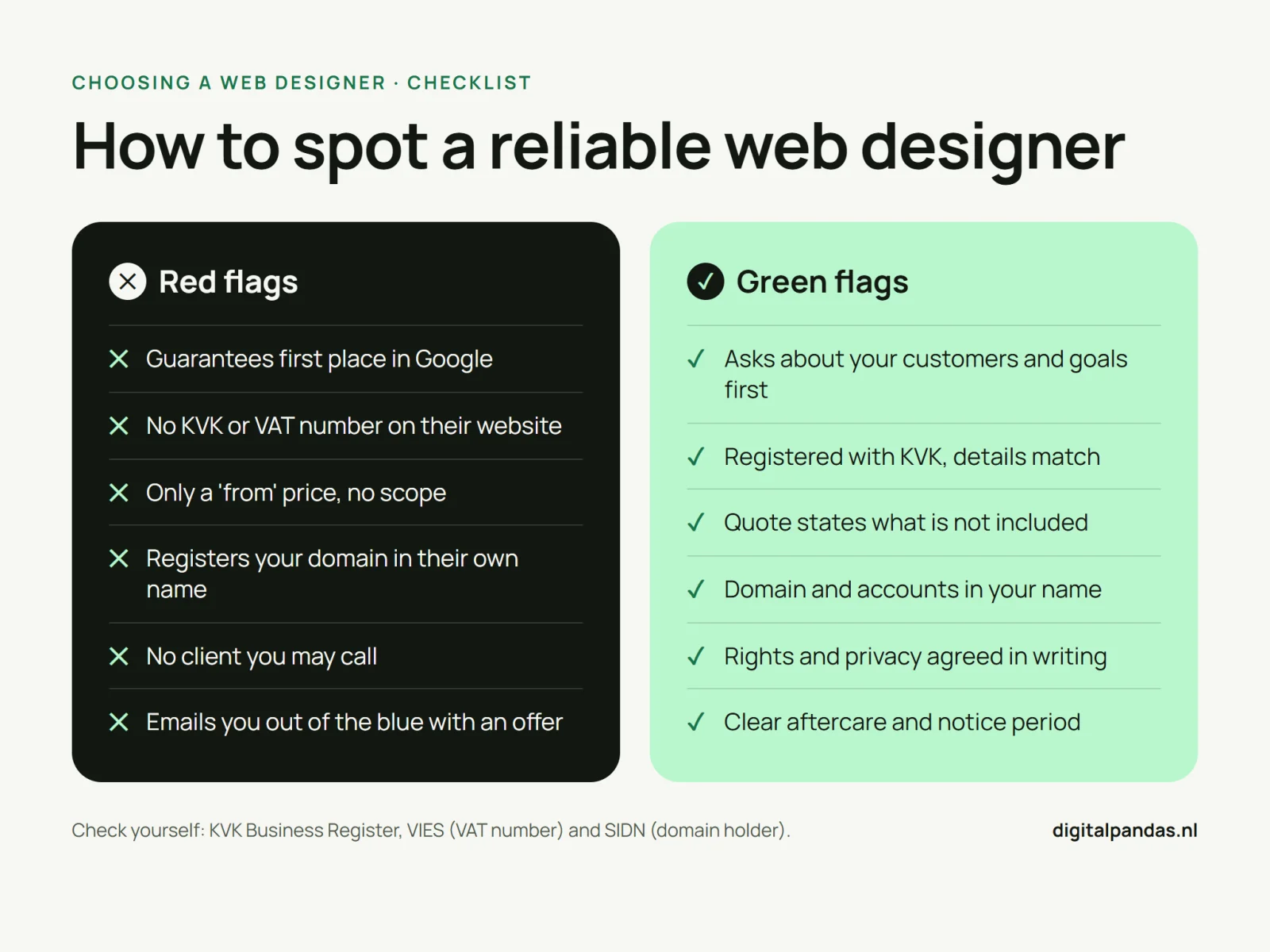
1. Check the business in the Business Register
A business operating in the Netherlands is registered with the Chamber of Commerce (KVK). Look up the business name or KVK number in the Business Register and check whether the address and business activities match what you heard in the meeting. An extract also shows who may represent the business and therefore sign contracts. The register also shows whether a business is bankrupt or has a suspension of payments.
Look at the web designer’s own website too. Businesses offering services online must state their KVK number and VAT identification number, among other details. You can check a VAT number for free in the European Commission’s VIES system. Are these details missing, or do they not match the register? Ask for an explanation.
2. Pay attention to the questions they ask you
A reliable partner first wants to understand your business. Who are your customers, what should the website achieve, who are your competitors and how do customers find you now? Google gives the same advice for choosing an SEO specialist: a good partner asks what makes your business unique and how your customers search. If the conversation starts with colours and fonts, the design mainly becomes a matter of taste.
3. Distrust promises nobody can keep
Does someone promise you first place in Google? Google itself says that in that case you should find someone else. Nobody can guarantee a position in the search results, and Google does not accept money to rank websites higher in its free results. Advertising with Google has no effect on your organic position either.
Google also warns about agencies that email you out of the blue, and about parties that use link schemes or submit your website to thousands of search engines. A reliable web designer is honest about what is achievable, and about the role of good content and SEO.
4. Ask for work and clients you can verify
A portfolio is only credible if the websites are still online and the web designer can explain what they did themselves. Design, development, copy and photography may have been supplied by different parties. Ask about a project with a similar goal, such as generating enquiries or selling online. For example, see in our projects how we describe what we did for each assignment.
Also ask for one or two clients you may call. The Chamber of Commerce mentions references as a way to check a business partner. Ask that client whether deadlines were met, how problems were solved and whether there was support after launch.
5. Read reviews critically
A business’s own website naturally shows the best feedback. So also look at reviews on Google. Google prohibits reviews given in exchange for a reward, such as money or a discount, and reviews from people with a conflict of interest. Do you see a striking number of five-star reviews in a short time, without substance? Be careful. Above all, look at how a business responds to criticism: professionally and to the point, or defensively? Read more about reviews and your Google Business Profile in our practical plan for local SEO.
6. A reliable quote is specific
A “from” price without a description makes quotes impossible to compare. A good quote states at least:
- which pages and features you get, and what is not included;
- who supplies the copy and images;
- the number of feedback rounds and the schedule;
- the rate for additional work;
- whether amounts include or exclude VAT;
- the cost of hosting and maintenance after launch.
Also request the general terms and conditions before you sign, and read what they say about ownership, liability and cancellation. Want to know which amounts are realistic? Read how much a website costs in the Netherlands and how to compare quotes fairly.
7. Make sure the domain, accounts and rights are yours
This is where things most often go wrong later. Three things to arrange in advance:
- Your domain name in your business’s name. For a .nl domain, only the registrant (holder) may make changes, such as moving to another hosting provider. If the domain is registered in your web designer’s name, you need that person to move it. When you move, SIDN, the .nl registry, requires your current registrar to provide the transfer token within five days of your request.
- Your own administrator accounts. Make sure you have your own login for the website, hosting, Google Search Console and Google Analytics.
- Rights to the design and copy. Under Dutch law, copyright in principle stays with the creator. According to the Dutch Copyright Act, it only transfers through a written deed, and an exclusive licence must also be agreed in writing. So record whether you receive the copyright or a right of use, and what you may take with you if you switch. Paid themes and plugins are usually licensed by the maker of that software.
8. Ask about privacy and a data processing agreement
Does your website collect personal data, for example through a contact form, and does your web designer host or manage the website? Then that party processes data on your behalf. The Dutch Data Protection Authority states that you must then sign a data processing agreement. If it is missing, both parties are in breach. A reliable web designer offers this agreement themselves. Also ask how cookies and consent will be set up. Our article on Google Consent Mode explains what to look out for.
9. Clarity about aftercare and maintenance
After launch, a website needs updates, backups and security. Ask what is included as standard, what is charged separately and who you call when something breaks. Also ask how to cancel maintenance and how a handover to another party works. A reliable web designer makes it easy to leave, even though they naturally hope you will stay.
Checklist: 10 questions for your next meeting
- What is your KVK number, and who signs on behalf of the business?
- What do you want to know about my customers and goals before you design?
- What results do you expect, and how will we measure them?
- Which similar projects have you done, and which part did you make yourself?
- Which client may I call as a reference?
- What is not in the quote, and what does additional work cost?
- In whose name will the domain name and hosting be registered?
- Do I get the copyright or a right of use, and is that in writing?
- Will we sign a data processing agreement?
- What happens after launch, and how do I cancel?
A reliable partner does not need an immediate answer to everything. But they do say when you will get the answer, and they follow up.
Going further: measure whether it works after launch
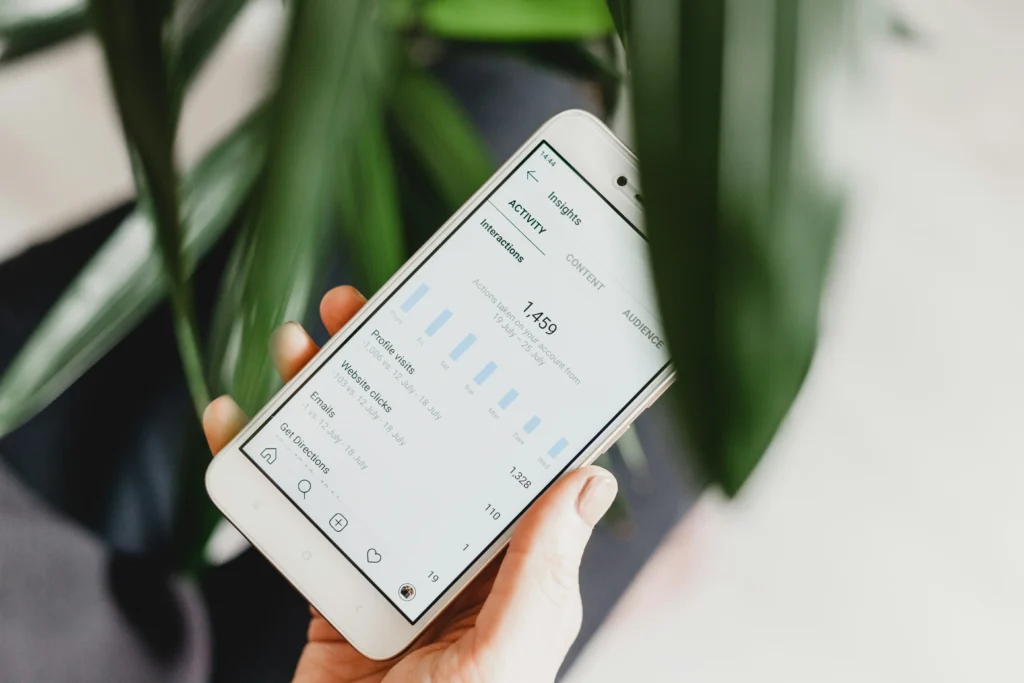
Reliability does not stop at delivery. Agree how you will assess together whether the website does its job: more enquiries, better enquiries or fewer questions by phone. Set those goals up in Google Analytics, so you do not depend on your web designer’s gut feeling. Read how in improve your website with GA4. And because design and findability go together, also read SEO and web design.
How Digital Pandas works
You are welcome to ask us all of these questions. After an introductory meeting, at your location or in Julianadorp, you receive a proposal with a clear scope and investment, including what is not included. See our approach to web design or get to know our team first. Mainly looking for help with visibility? Read how to choose a local SEO agency.
Frequently asked questions about choosing a reliable web designer
Is a cheap web designer unreliable?
No. A low price can be right if the website is simple or if someone works efficiently. It only becomes a risk if it remains unclear what you get for that price. Always ask what is and is not included in the quote.
May a web designer register my domain name in their own name?
It happens, but it is unwise. For a .nl domain, only the holder may make changes. So ask for the domain to be registered in your business’s name from the start. You can request the holder details through SIDN.
What if my web designer stops trading or goes bankrupt?
Then you want another party to be able to continue without rebuilding everything. That works if the domain is in your name, you have your own administrator accounts, there are backups and your rights are recorded in writing. Whether a business is bankrupt is shown in the Chamber of Commerce Business Register.
Does a web designer need to be close by?
Not necessarily, but it helps if you can meet easily. The Chamber of Commerce mentions a personal meeting as a good way to see how a business works. More important than distance is experience with your type of goal, such as generating enquiries or selling online.
Digital Pandas helps business owners in Julianadorp, Den Helder and the rest of North Holland get a website with clear agreements. Unsure about a quote or a web designer? Tell us what you want to improve.